
A Daily Pill for HS? Phase 3 Results Show Sustained Relief with Oral Povorcitinib
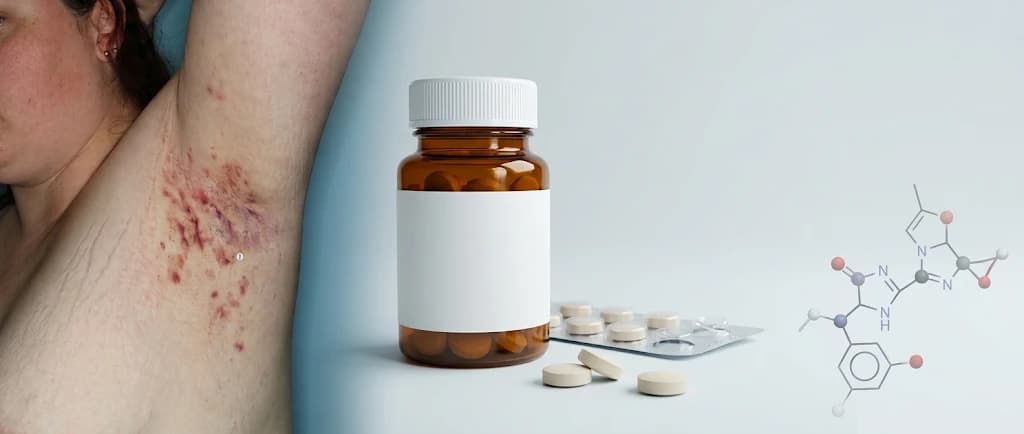
A potential new daily pill for hidradenitis suppurativa
Hidradenitis Suppurativa (HS) is a chronic inflammatory skin condition that causes painful nodules, abscesses, and draining tunnels, most often in sensitive areas like the underarms, groin, and inner thighs. While several injectable biologic treatments are available today, researchers have been studying povorcitinib, a daily oral medication (a pill rather than an injection), to see if it can help control HS symptoms.
What did the Phase 3 trial find?
Recent 54-week results from the major STOP-HS1 and STOP-HS2 Phase 3 clinical trials evaluated adults with moderate-to-severe HS taking povorcitinib once daily. Highlights include:
- Fewer inflammatory lesions: Over 70% of participants achieved at least a 50% reduction in abscesses and inflammatory nodules (known as a HiSCR50 response).
- Higher levels of clearance: Nearly 30% of participants experienced a complete absence of new or active inflammatory lesions (HiSCR100) during the trial.
- Pain relief: Many participants reported a noticeable drop in skin pain within the first few weeks of starting treatment. By week 24, a significant majority experienced mild or no pain.
- Effective after biologics: Patients who had previously tried and stopped other biologic injections (like anti-TNF therapies) still showed strong responses to povorcitinib.
Important note for patients
Is povorcitinib available now? Povorcitinib is an investigational medication. It is currently undergoing regulatory review and is not yet approved by the FDA or international health authorities. Speak with your dermatologist to discuss current FDA-approved treatment options or to learn about participating in ongoing clinical trials.
Information for physicians and researchers
Mechanism of action
Povorcitinib is an oral, highly selective Janus Kinase 1 (JAK1) inhibitor. In HS pathogenesis, signaling via the JAK/STAT pathway mediates downstream inflammatory responses driven by key cytokines including IL-6, IFN-gamma, and IL-23. By selectively blocking JAK1 phosphorylation, povorcitinib interrupts multiple convergent inflammatory signals without significant inhibition of JAK2, JAK3, or TYK2 at therapeutic doses.
Clinical trial data and efficacy metrics
Data from the twin Phase 3 STOP-HS1 (NCT05628116) and STOP-HS2 (NCT05628129) pivotal trials evaluated oral povorcitinib (75 mg once daily vs. 45 mg once daily vs. placebo) in adults with moderate-to-severe HS over 54 weeks:
- Primary endpoint (HiSCR50 at Week 16): Both dosing cohorts met statistically significant HiSCR50 response rates compared to placebo, with sustained responses demonstrated through Week 54 (up to 71.4% HiSCR50 in the 75 mg cohort).
- Secondary and exploratory endpoints:
- HiSCR75: Achieved in up to 57% of patients in the high-dose cohort at Week 54.
- HiSCR100: Complete resolution of inflammatory nodules and abscesses achieved in up to 29% of patients.
- Draining tunnel response: Demonstrated durable reductions in active draining tunnel counts and chronic fistulous tract inflammation.
- Patient-reported outcomes: Rapid, statistically significant improvements in Numeric Rating Scale (NRS) skin pain scores were observed as early as Week 3, maintained through Week 54.
- Subgroup efficacy: Comparable efficacy outcomes were maintained among both biologic-naive patients and patients with prior biologic failure (anti-TNF and/or anti-IL-17 exposure).
Safety profile and clinical considerations
- Through 54 weeks, the safety profile of povorcitinib was consistent with established oral JAK1 inhibitor safety signals.
- Most common treatment-emergent adverse events (TEAEs) included mild-to-moderate upper respiratory tract infections, acneform eruptions, blood creatine phosphokinase (CPK) elevation, and headache.
- As with the broader JAK inhibitor class, laboratory monitoring (CBC, LFTs, lipid panel, serum creatinine/CPK) and baseline screening for latent infections (TB, viral hepatitis, VZV) remain standard clinical protocol considerations.
Primary references
- STOP-HS1 (NCT05628116): A Study to Evaluate the Efficacy and Safety of Povorcitinib in Participants With Moderate to Severe Hidradenitis Suppurativa.
- STOP-HS2 (NCT05628129): A Phase 3 Study Evaluating Oral Povorcitinib in Adults With Active Moderate-to-Severe Hidradenitis Suppurativa.
- Porter, M. L., Martorell, A., Sayed, C. J., Bechara, F. G., Lev-Tov, H., Hsiao, J. L., Frew, J. W., Reguiaï, Z., Gooderham, M. J., Goldfarb, N., van der Zee, H. H., del Marmol, V., Marzano, A. V., Ehst, B. D., & Ackerman, L. S. (2026). Povorcitinib for hidradenitis suppurativa: the randomized, double-blind, placebo-controlled STOP-HS1 and STOP-HS2 phase 3 trials. Nature Medicine, 32(8), 3071–3081.
- Kirby, B., et al. (2023). Efficacy and Safety of Oral Povorcitinib (INCB054707) in Patients with Moderate-to-Severe Hidradenitis Suppurativa: A Phase 2, Randomized, Double-Blind, Placebo-Controlled Study. Journal of the American Academy of Dermatology (JAAD), 89(6), 1147–1156. doi:10.1016/j.jaad.2023.07.1021
- Late-Breaking Research Presentation: 54-Week Results from the Phase 3 STOP-HS Clinical Trial Program for Povorcitinib in Hidradenitis Suppurativa. American Academy of Dermatology (AAD) Annual Meeting.
Disclosure
I have no financial interest or conflict of interest related to this medication or its manufacturer, and I received no payment for writing this post.
This post is for general educational purposes and is not a substitute for individual medical advice.